Built for Singapore mosques, by people who understand what they actually need.
Awqōt started with a simple frustration: mosque displays that get the basics wrong. Hijri dates that roll over at midnight instead of Maghrib. Prayer times pulled from apps never designed for a specific congregation. A display that goes dark every time someone unplugs it to switch inputs for a laptop or projector, and doesn't come back until someone remembers to plug it back in.
We built Awqōt to fix that — a display system that treats prayer times, Hijri dates, and announcements as the core product, not an afterthought bolted onto something else.
That includes the moment khutbah or a lecture starts. Sessions now run through the same screen as everything else — no unplugging a working display to make room for a laptop, no gap while someone finds the right cable again.
Every prayer time comes from MUIS.
Not a generic international API adjusted after the fact — a deliberate choice. Mosques here shouldn't have to double-check whether a display is showing the right time for the right place.
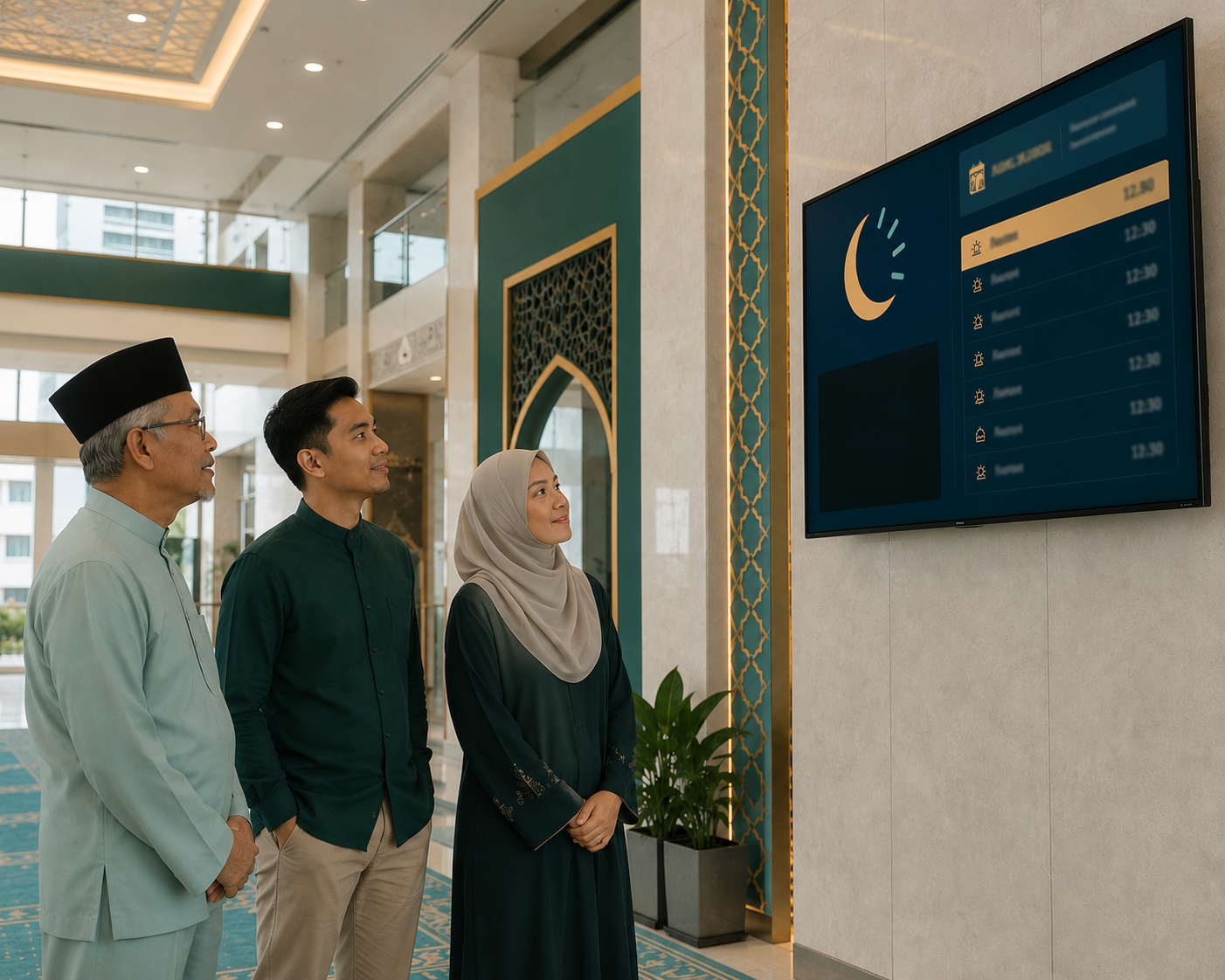
A one-time build, not a subscription business.
Awqōt was designed from day one with minimal ongoing costs in mind. That means it's free for Singapore mosques, and it stays that way.

Accurate. And worth looking at.
In Surah An-Nisa (4:103), prayer is described as salatan mawqutan ("Indeed, performing prayers is a duty on the believers at the appointed times"). Awqōt (أوقات) is the plural of waqt. We named the platform after that duty.
Long before displays or databases, mosques had a person for this exact job: the muwaqqit — an officer trained in the astronomy and mathematics of the day, responsible for getting prayer times right and telling the muezzin when to call. Getting the time correct wasn't a side duty. It was the discipline itself.
Some of the people who held that role are still remembered for it. Ibn al-Shatir, the 14th-century muwaqqit of Damascus's Umayyad Mosque, built a sundial precise enough that his astronomical work echoed in scholarship centuries later. Al-Jazari, an engineer a century before him, built water clocks that tracked the sun, moon, and stars through mechanical motion alone. And in 16th-century Istanbul, Taqi al-Din built a clock accurate to the second — housed, like many of these instruments, in a mosque timekeeping office funded the same way Awqōt is: as a waqf.
We didn't set out to recreate that lineage. But building a display that insists on getting prayer times exactly right — sourced from the right authority, rolling over at the right moment — turned out to be the same job, just running on different tools.
Get your mosque's display running today.
Free for all mosques. No credit card, no commitment.
Sign Up Free